Introduction:
The iPhone 11 and Samsung Galaxy S20 are two older flagship smartphones that continue to attract buyers looking for premium features at a more affordable price. Apple launched the iPhone 11 in 2019, while Samsung introduced the Galaxy S20 in 2020. Both devices offer capable cameras, quality displays, and performance that can still handle many everyday tasks.
The iPhone 11 features Apple’s A13 Bionic processor, a dual-camera system, and the familiar iOS experience. It also has a durable design and reliable video recording capabilities that appeal to social media users.
Samsung’s Galaxy S20 offers a more advanced display on paper, with a Dynamic AMOLED 2X panel and a refresh rate of up to 120Hz. It also includes a triple-camera system, a USB-C port, and an Android interface with additional customisation options.
Although both phones were premium devices at launch, their age matters when buying one in 2026. Battery degradation, software support, replacement parts, and the price of refurbished units should all be considered before making a decision.
In this comparison, we look at their specifications, historical Indian launch prices, cameras, performance, battery life, and major features to help you decide which phone suits your needs.
iPhone 11 vs Samsung Galaxy S20: Specifications
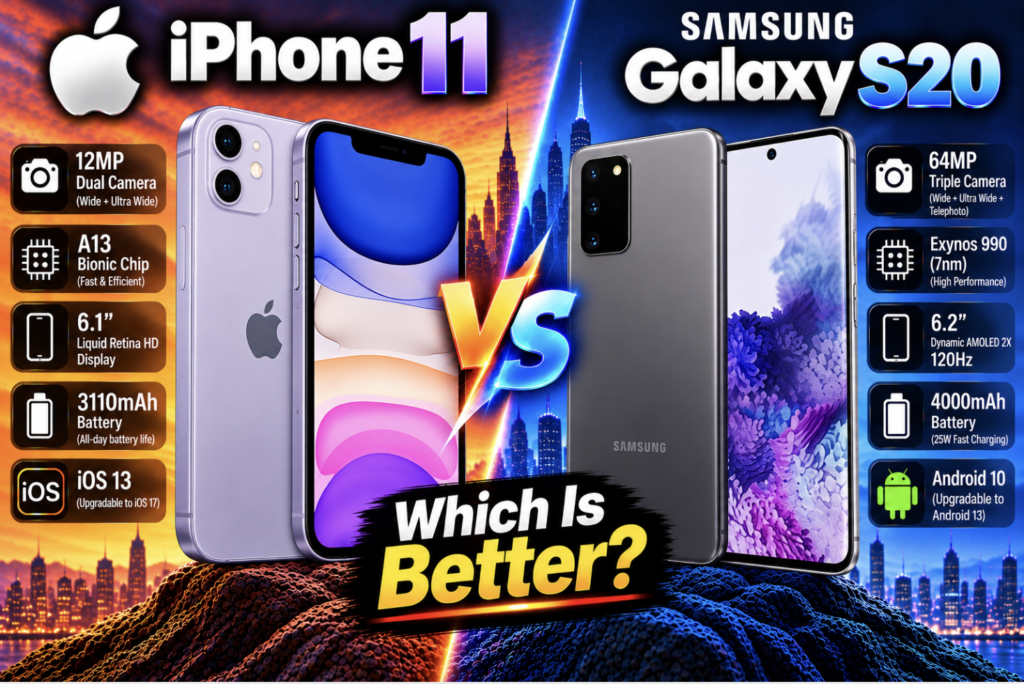
| Specification | Apple iPhone 11 | Samsung Galaxy S20 |
|---|---|---|
| Launch Year | 2019 | 2020 |
| Operating System at Launch | iOS 13 | Android 10 with One UI 2 |
| Display | 6.1-inch Liquid Retina HD LCD | 6.2-inch Dynamic AMOLED 2X |
| Resolution | 1792 × 828 pixels | 3200 × 1440 pixels |
| Refresh Rate | 60Hz | Up to 120Hz at supported resolution settings |
| Processor | Apple A13 Bionic | Exynos 990 or Snapdragon 865, depending on market |
| Rear Cameras | 12MP main + 12MP ultrawide | 12MP main + 64MP telephoto + 12MP ultrawide |
| Front Camera | 12MP | 10MP |
| Battery | Approximately 3,110mAh | Approximately 4,000mAh |
| Wired Charging | Fast charging supported | Fast charging supported |
| Wireless Charging | Qi wireless charging | Qi wireless charging |
| 5G Support | No | Yes, on Galaxy S20 5G variants |
| Water Resistance | IP68 | IP68 |
| Biometrics | Face ID | Under-display fingerprint sensor and face recognition |
| Charging Port | Lightning | USB-C |
| Expandable Storage | No | Supported on many Galaxy S20 variants |
Specifications may vary by regional variant. The Galaxy S20’s 120Hz mode operates at a lower resolution than its maximum QHD+ resolution.
Price in India
The following prices are historical launch prices in India, not current market prices.
| Model | Historical Launch Price |
|---|---|
| Apple iPhone 11 (64GB) | ₹64,900 |
| Apple iPhone 11 (128GB) | ₹69,900 |
| Samsung Galaxy S20 (8GB/128GB, 4G variant) | Approximately ₹66,999 |
| Samsung Galaxy S20+ (for reference) | Launched at a higher price |
The Galaxy S20’s price varied by configuration and connectivity variant. Current prices for the iPhone 11 and Galaxy S20 depend on availability, storage, condition, seller, and warranty. As these are older models, used and refurbished units are more likely than brand-new official stock.
1. Display and Design
The iPhone 11 comes with a 6.1-inch Liquid Retina HD LCD display. While it does not use OLED technology, it offers good colour reproduction, comfortable everyday viewing, and Apple’s True Tone feature. The phone has rounded edges and an aluminium frame with a glass back.
The Samsung Galaxy S20 features a 6.2-inch Dynamic AMOLED 2X display with much higher resolution and support for a refresh rate of up to 120Hz. Scrolling through websites, navigating menus, and using supported games can feel smoother on Samsung’s screen.
Samsung also offers deeper blacks and stronger contrast because of its AMOLED panel. The iPhone’s LCD display remains usable for everyday tasks, but it cannot match the Galaxy S20 in resolution or refresh-rate flexibility.
Display winner: Samsung Galaxy S20. Its AMOLED technology, higher resolution, and 120Hz option give it a clear advantage.
2. Camera Comparison
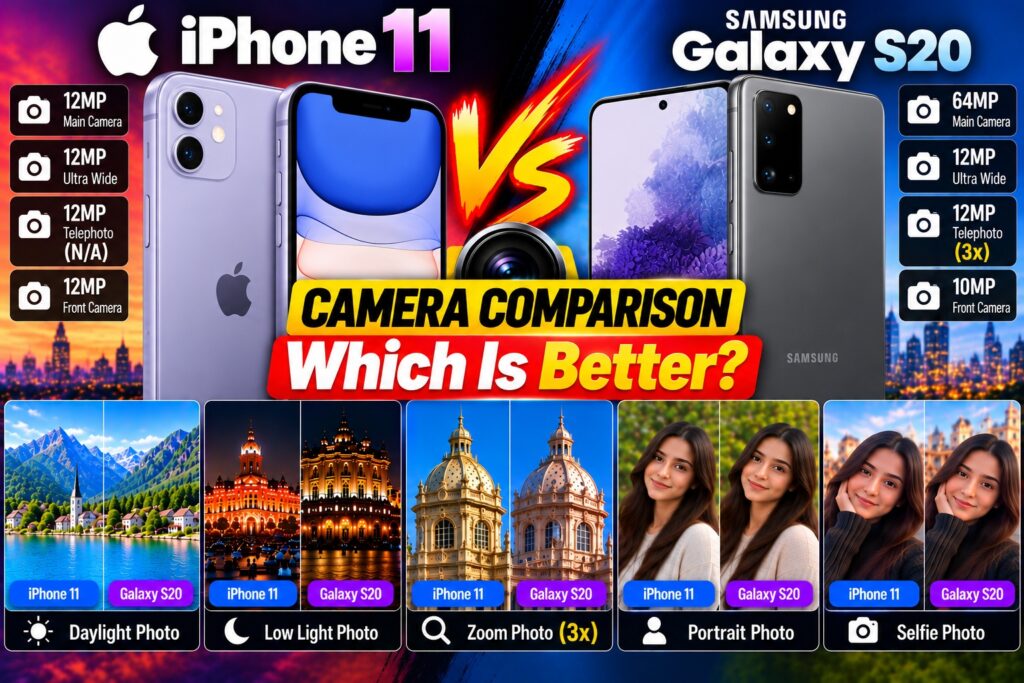
The iPhone 11 has a 12MP main camera and a 12MP ultrawide camera. It supports Night mode, Portrait mode, and 4K video recording at up to 60 frames per second. Apple’s camera processing produces consistent results, and its video quality remains useful for recording everyday clips and social media content.
The Galaxy S20 has a triple rear-camera setup with a 12MP main camera, a 12MP ultrawide camera, and a 64MP telephoto camera. Its telephoto hardware provides additional flexibility for zoom photography, while the high-resolution sensor supports detailed images in suitable conditions.
Both phones can capture good photos in daylight. The iPhone 11 is particularly appealing to people who value straightforward photography and video recording, while the Galaxy S20 provides more options for zooming and framing subjects.
Low-light results depend on the scene and software processing. Because both devices are several years old, the condition of the camera lenses and whether the phone has undergone repairs are also important.
Camera winner: Samsung Galaxy S20 for versatility; iPhone 11 remains a strong choice for video and consistent everyday photography.
3. Performance and Gaming
Apple’s A13 Bionic chip powers the iPhone 11. It was a high-performance processor at launch and can still handle messaging, browsing, streaming, and many popular games. Apple’s integration of hardware and software helps the phone deliver a consistent experience.
The Galaxy S20 uses the Exynos 990 in some markets and the Snapdragon 865 in others. Both were flagship-class processors, but performance and thermal behaviour can differ between variants.
Samsung’s high-refresh-rate display can make supported games and system animations appear smoother. The iPhone 11, however, continues to offer capable performance for many everyday applications.
Neither phone should be purchased for demanding gaming without considering its age. Older batteries, heat, storage limitations, and app requirements can affect the experience. Check the exact Galaxy S20 processor variant before buying.
Performance winner: Both remain suitable for many everyday tasks. The best option depends on the specific variant, game requirements, and device condition.
4. Battery Life and Charging
The iPhone 11 has an approximately 3,110mAh battery, while the Galaxy S20 has an approximately 4,000mAh battery. However, battery capacity alone does not determine real-world battery life because display technology, refresh rate, processor efficiency, and software all affect power consumption.
Samsung supports USB-C charging and wireless charging. The iPhone 11 uses Apple’s Lightning connector and supports Qi wireless charging. Both phones support wired fast charging with compatible equipment, although the included accessories vary by package.
In 2026, battery health is one of the most important considerations when buying either phone second-hand. An original battery that has been used for several years may deliver noticeably less runtime than it did when new.
On the iPhone 11, check Battery Health in Settings. For the Galaxy S20, test battery performance during normal use and check for unusual heating, swelling, or charging problems.
Battery winner: The result depends on battery condition and usage. Samsung has a larger nominal battery, but that does not guarantee longer runtime.
5. Software and Features
The iPhone 11 runs Apple’s iOS platform and integrates with services such as iCloud, AirDrop, FaceTime, and other Apple devices. Its interface is familiar and relatively straightforward for people already using Apple products.
The Galaxy S20 runs Android with Samsung’s One UI interface. It offers customisable home screens, flexible file management, and additional control over many system settings. Many Galaxy S20 variants also support expandable storage, which can be useful for people who keep lots of photos and videos.
Connectivity is another difference. The iPhone 11 supports 4G LTE but does not support 5G. The Galaxy S20 is available in 4G and 5G variants, so buyers should confirm the exact model number if 5G is important.
Software support is especially relevant in 2026. Both models are older, and their remaining security-update eligibility differs. Check official support information for the exact model and region before relying on either phone for sensitive tasks.
Software winner: The iPhone 11 suits users who prefer iOS, while the Galaxy S20 offers Android flexibility and 5G connectivity on supported variants.
Pros and Cons
Apple iPhone 11
Pros
- Capable A13 Bionic processor.
- Consistent camera performance and good video recording.
- Night mode for low-light photography.
- IP68 water-resistance rating.
- Face ID and convenient Apple ecosystem integration.
- Simple and familiar iOS experience.
Cons
- LCD display rather than OLED.
- Standard 60Hz refresh rate.
- No 5G connectivity.
- Lightning charging port.
- No dedicated telephoto camera.
- Battery health may be reduced on older used units.
Samsung Galaxy S20
Pros
- High-resolution AMOLED display.
- Smooth refresh rate of up to 120Hz.
- Triple rear-camera setup with telephoto capability.
- USB-C charging port.
- 5G support on compatible variants.
- Expandable storage on many versions.
- Fingerprint sensor built into the display.
Cons
- Processor differs by market.
- 120Hz mode uses a lower display resolution.
- Older battery may need replacement.
- Remaining software support is limited compared with newer phones.
- Used units may have display burn-in or repair-related problems.
Which Phone Should You Buy in India?
The iPhone 11 and Samsung Galaxy S20 can both serve as budget-friendly older flagships, but they suit different types of users.
Choose the iPhone 11 if you prefer iOS, use other Apple devices, want dependable video recording, and do not need 5G. It can be a reasonable purchase if its battery is healthy and the price reflects its age.
Choose the Samsung Galaxy S20 if you prioritise display quality, a smoother 120Hz experience, more camera options, USB-C, or 5G on a compatible variant. Its AMOLED screen is a major advantage for video streaming and everyday browsing.
Before buying either phone in India, inspect the display, cameras, speakers, charging port, and battery. Check for screen burn-in on the Galaxy S20, verify Face ID on the iPhone 11, and confirm that the device is not carrier-locked or subject to an IMEI-related issue.
If your budget allows, compare both phones with newer entry-level and mid-range devices as well. A newer phone may provide a fresher battery, longer software support, and better long-term value.
Frequently Asked Questions
1. Which is better, iPhone 11 or Samsung Galaxy S20?
The Galaxy S20 is better for display quality, refresh rate, and camera versatility. The iPhone 11 is attractive to users who prefer iOS and Apple’s video-recording experience.
2. Does the Samsung Galaxy S20 have a better display than the iPhone 11?
Yes. The Galaxy S20 features a high-resolution AMOLED display with up to a 120Hz refresh rate, while the iPhone 11 uses a 60Hz LCD panel.
3. Does the iPhone 11 support 5G?
No. The iPhone 11 supports 4G LTE but does not have 5G connectivity.
4. Does the Samsung Galaxy S20 support 5G?
Some Galaxy S20 models support 5G, while others are 4G-only. Check the exact model and regional variant before purchasing.
5. Which phone is better for photography?
The Galaxy S20 offers more camera flexibility because it includes a telephoto camera. The iPhone 11 is also capable and is particularly appealing for straightforward photography and video recording.
6. Which phone has better battery life?
Neither phone is guaranteed to last longer, especially when buying used. The Galaxy S20 has a larger nominal battery, but display settings, usage, and battery degradation all affect real-world results.
7. Is it worth buying the iPhone 11 or Galaxy S20 in 2026?
Either may be worth considering at a suitably low price if the device is in good condition. However, compare software support, battery health, repair history, and newer alternatives before making a decision.
Conclusion
The iPhone 11 vs Samsung Galaxy S20 comparison highlights two different approaches to a premium smartphone. The iPhone 11 offers a capable processor, dependable video features, and Apple’s familiar software ecosystem. The Galaxy S20 delivers a sharper AMOLED display, a smoother refresh rate, a telephoto camera, and 5G support on compatible versions.
For display quality and camera flexibility, the Samsung Galaxy S20 has the stronger hardware package. For users who prefer iOS and Apple’s ecosystem, the iPhone 11 remains an option worth considering.
Ultimately, the best choice in India depends on the current selling price, battery health, model variant, and software-support requirements. Always inspect the phone carefully before purchasing a used or refurbished device.